
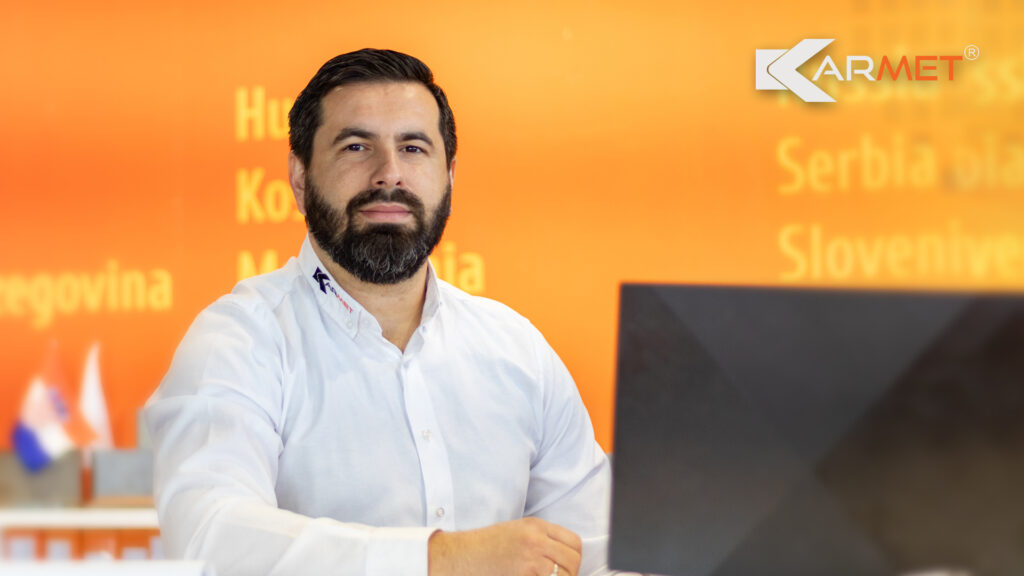
Eng. Cuneyt Mustafa – Regional Manager.
When investing in an industrial machine, the purchase price is important. But it is only one part of the real value of the investment.
When choosing equipment, one must look much further than the day of delivery – towards performance, reliability, the correct configuration, operating costs, service support, and the time the machine will create value for the enterprise.
Experience in both service and sales of metalworking machinery shows one thing: a good investment does not start with the lowest price, but with the right choice of solution.
When price is the main criterion
The purchase of production equipment is a serious investment and it is completely natural for any company to seek the optimal balance between price and capabilities.
The problem arises when the purchase price becomes the only criterion.
Two machines can have similar power, working area, tonnage or other basic parameters and at first glance appear almost identical.
In practice, the differences can be significant.
The configuration, the components used, the software, the management systems, the quality of assembly, the availability of spare parts, the training and the service support are part of the actual value of the machine just as much as the technical parameters specified in the offer.
Lower purchase price does not always mean lower cost
When evaluating an investment, there is one more important question:
„How much will this machine cost to produce?“
The purchase price is paid once. The costs and revenues from the machine are accumulated throughout the entire period of its operation.
A lower initial investment may be attractive. But if the machine subsequently has lower productivity, unsuitable configuration, frequent downtime, or difficult servicing, the initial savings may quickly lose their significance.
For a manufacturing company, the most expensive machine is not always the one with the highest purchase price.
The most expensive thing could be the machine that doesn’t work when production needs it.
The configuration must follow the production
There is no one universal configuration suitable for all enterprises.
When choosing a fiber laser, for example, it is not enough to compare only the power of the laser source and the size of the worktable.
It is necessary to analyze:
• the materials that will be processed;
• predominant thicknesses;
• the dimensions of the details;
• the required production capacity;
• the technological gases used;
• the level of automation;
• future plans for the development of production.
The same principle applies to the abanket presses, the guillotine machines, the straightening machines, and the rest of the production equipment.
Therefore, the right question is not:
„Which is the cheapest machine that meets these parameters?“
a:
„Which configuration is best suited for my production?“
The difference between these two issues often determines the quality of the investment decision as well.
What happens after delivery?
When comparing offers, the service sometimes takes a back seat.
While the machine is new and works flawlessly, after-sales support may seem like something that will be needed in the future.
But every industrial machine requires proper operation and maintenance. Over time, the need arises for consumables, spare parts, preventive maintenance, diagnostics, or technical intervention.
Then the important questions are very practical:
Is anyone going to respond?
Can the problem be diagnosed quickly?
Is the necessary spare part available?
How long will it take for the machine to start working again?
For production, time has a specific value.
A one-day delay can mean delayed orders, incomplete deliveries, and additional costs. In a busy production environment, several days of downtime can cost significantly more than the savings from the initial purchase.
A car directly from China – a good or a bad idea?
This question is asked more and more often, but there is no universal answer.
It is not right that the quality of a machine should be determined solely by the country in which it was manufactured.
The Chinese industry produces both high-tech equipment and components, as well as solutions developed primarily around a minimum purchase price.
Therefore, the more important question is not:
„China or Europe?“
a:
„What do I actually get?“
When evaluating, the following should be considered:
• who determined the configuration;
• what components have been used;
• for what production the machine is intended;
• how it was tested before delivery;
• who will perform the installation and adjustment;
• who will train the operators;
• who is responsible in case of a technical problem;
• where and for how long spare parts can be delivered.
Direct purchase from the manufacturer can offer a price advantage. But the customer must also clearly understand what part of the technical, logistical and service responsibilities he or she shoulders himself.
Good sales do not end with delivery
With industrial equipment, the real result of an investment is not seen on the day the contract is signed.
It becomes visible over time:
• when the machine operates reliably;
• when productivity increases;
• when the customer places multiple orders;
• when the equipment continues to meet its production needs;
• when, with a subsequent investment, the client again trusts the selected partner.
Therefore, the successful sale of an industrial machine should not end with the delivery; it should be the beginning of a long-term technological partnership.
What should we compare before buying?
Before investing in a new machine, do not just compare prices.
Compare:
• the configuration;
• the components;
• real productivity;
• possibilities for future upgrades;
• the training;
• warranty conditions;
• the service organization;
• availability of spare parts;
• the expected operating costs;
• liability after delivery.
And most importantly – view the machine not just as a purchase, but as a production asset that should create value for years to come.
Sometimes the difference between two offers seems significant on the day of the purchase.
However, after several years of operation, it may prove to be small in comparison to the value of reliable and continuous production.
Therefore, the price of the machine and the price of the investment are not always the same.
The right machine is not necessarily the cheapest or the most expensive one.
The right machine is the one that is configured for the specific production, operates reliably, and has the right technical support behind it.